From material chemistry to three-dimensional structures.
MATERIAL → STRUCTURE
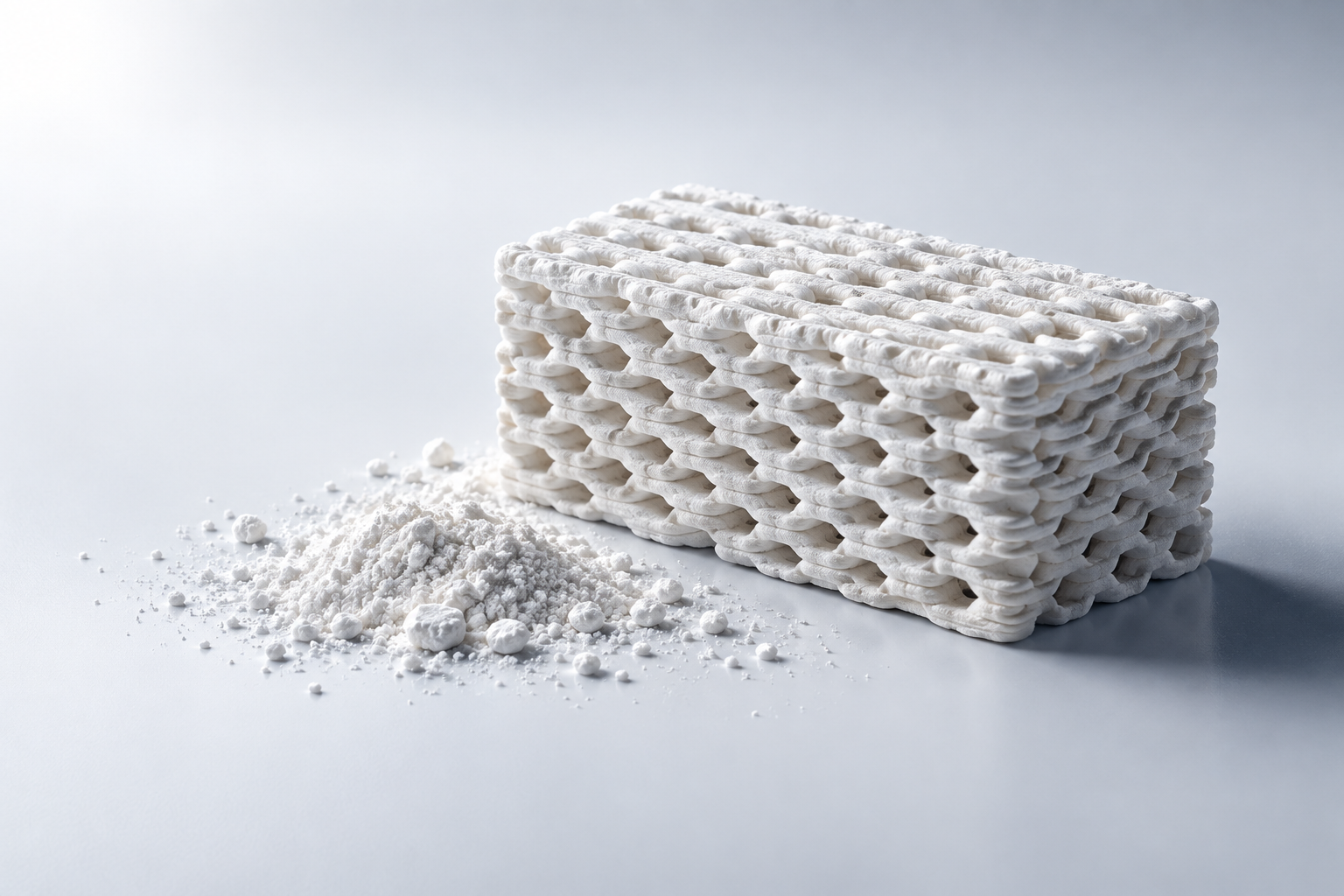
CPP / CALCIUM POLYPHOSPHATEConceptual material illustration
OUR DEVELOPMENT FOCUSCalcium polyphosphatePrintable ceramicsOrthopedics & dentistry
01 / COMPANY
About Us
Progress starts with the material.
Previously Orthopedic 3D
Ossiphora Biomed is developing a Canadian biomedical ceramics company around calcium polyphosphate, or CPP.
Our research began with CPP coatings on titanium-alloy implants. Today, our focus is expanding to material supply and printable ceramic formulations for bone-graft and scaffold development.
We connect materials science with manufacturing research, working toward reproducible materials that partners can evaluate for their own applications.
Materials scienceAdditive manufacturingApplication-led development
Our Team
CO-FOUNDER · CEO
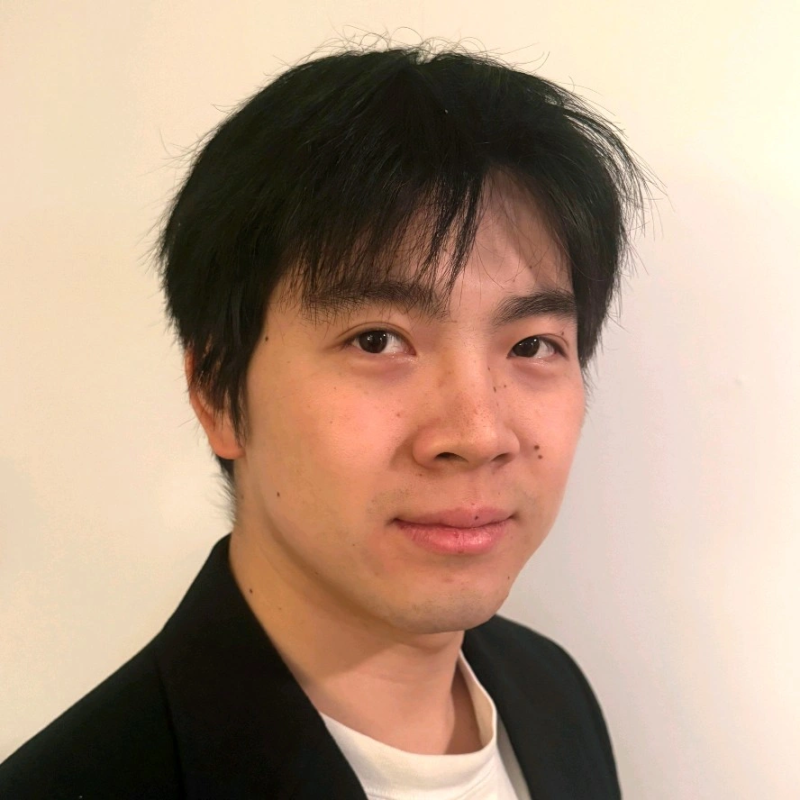
Zhengyanyan Leo Li M.Eng.
Technology development and commercialization
PhD Candidate University of Toronto
Zhengyanyan Leo Li is a PhD candidate at the University of Toronto, where he earned his bachelor’s and master’s degrees in materials engineering with focuses on biomedical engineering and advanced manufacturing. His research includes electrodeposition and bioceramics for orthopedic implants. As co-founder and CEO of Ossiphora Biomed, he leads technology development and commercialization.
Associate Professor · Dean’s Spark Professor Department of Materials Science & Engineering University of Toronto
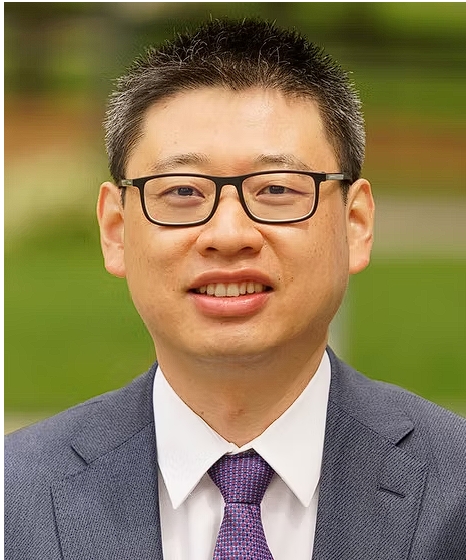
Prof. Yu Zou is an Associate Professor, Dean’s Spark Professor, and Canada Research Chair in Materials and Manufacturing for Extreme Environments at the University of Toronto. He leads the Laboratory for Extreme Mechanics & Additive Manufacturing, where his group studies advanced materials, multiscale mechanics, metal 3D printing, and machine learning. As an Ossiphora Biomed co-founder and advisor, he contributes expertise in materials science and additive manufacturing.
Professor Emeritus Department of Laboratory Medicine and Pathobiology University of Toronto
Prof. Marc Grynpas is a Professor Emeritus in the University of Toronto’s Department of Laboratory Medicine and Pathobiology, with an affiliation in the Institute of Biomedical Engineering. His research examines bone mineral and matrix, skeletal tissue engineering, and the factors that affect bone quality and fragility. As an Ossiphora Biomed co-founder and advisor, he contributes expertise in biomedical materials and bone research.
Our platform centers on CPP, a chain-structured calcium phosphate ceramic. We study how composition and processing influence its behavior.
THE MATERIAL PLATFORM
Calcium polyphosphate[Ca(PO3)2]n
Material details
Material development guided by phase composition, particle characteristics, and degradation behavior.
CompositionProcessingPerformance
01
MATERIAL DEVELOPMENT
CPP powders
Working toward specification-controlled powders for research and future medical-device supply chains, with an emphasis on reproducibility and material characterization.
02
FORMULATION DEVELOPMENT
Printable ceramic formulations
Developing CPP-based printing inks for three-dimensional scaffold fabrication. Current work explores extrusion, shape retention, and compatibility with subsequent processing.
03 / APPLICATIONS
Designed around real research questions.
We explore material formats for orthopedic and dental applications, from implant surfaces to three-dimensional structures.
A / SURFACES
Implant coatings
Research focus
Electrodeposition, coating integrity, adhesion, and material behavior under laboratory evaluation.
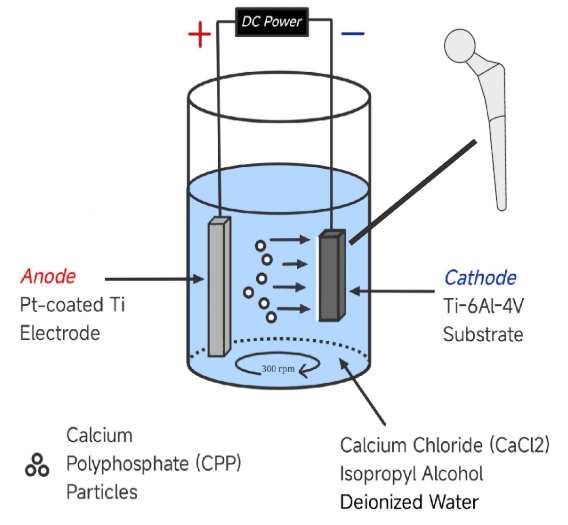
Our patent-pending electrodeposition approach to CPP coatings on titanium alloys combines a low-cost process with high coating strength. It underpins our research into material–implant interfaces.
Zhengyanyan Leo Li, Barmaan Shafiee, Nuo Qu, Ruitian Chen, Mingyu Xie, Jingjie Wei, Marc Grynpas, Yu Zou; Electrodeposition of Calcium Polyphosphate on Ti-6Al-4V Substrates for Rapid Osseointegration in Orthopedic Applications. ACS Appl. Bio Mater. 6 July 2026; 9 (13): 5823–5836. https://doi.org/10.1021/acsabm.6c00504
B / MATERIALS
Bone-graft development
Research focus
Degradation behavior, mechanical performance, and biological response for defined applications.
Investigating CPP as a mineral-based bone-graft platform for orthopedics and dentistry, with the aim of reducing reliance on autografts and animal-sourced bone grafts.
C / STRUCTURES
Printed scaffolds
Research focus
Printability, pore architecture, shape retention, and scaffold integrity after processing.
Exploring ceramic formulations and direct ink writing to create structures with controlled porosity and tailored mechanical strength for customized bone grafts and conventional block grafts.
Current stage: research & development
We are developing materials and evaluating intended applications. Commercial supply and clinical use are future objectives subject to product qualification and appropriate authorization.
04 / PARTNERSHIPS
Build the next step with us.
Our intended business-to-business model brings material development closer to the needs of device manufacturers, bone-graft developers, and research collaborators.
We acknowledge funding support from the Natural Sciences and Engineering Research Council of Canada (NSERC) and the Connaught Innovation Award. Nous remercions le CRSNG et le programme Connaught Innovation Award de leur soutien financier à notre recherche.